Travel Identity Document
A travel identity document is a travel document for which some foreigners can apply if they do not have a valid travel document and they cannot get a new one in the country of which they are nationals for reasons beyond their control1.
The document is issued with territorial validity to all countries of the world. However, it is advisable to check whether it is recognised in destination or transit countries.
GENERAL INFORMATION
APPLICATION
Who can apply for a travel identity document?
The Ministry will issue a travel identity document to leave the country for the foreign nationals who do not have a valid travel document and prove that they cannot get a new one for reasons beyond their control and who:
- hold a long-term residence permit or a temporary residence permit of an EU citizen’s family member in the Czech Republic. The travel document will be issued with a validity of a maximum of 180 days.
- hold in the Czech Republic a visa for a stay longer than 90 days for the purpose of tolerated stay under Section 33 (1a) or (1b) or who have been issued such a visa under specific legislation. The travel document will be issued with a validity of a maximum of 365 days.
- hold a long-term residence permit for the purpose of tolerated stay under Section 33 (1a) or (1b). The travel document will be issued with a validity of a maximum of 365 days.
The Ministry will also issue a travel identity document to the foreign nationals who are staying in the Czech Republic without a valid travel document after:
- A decision to revoke a visa for a stay longer than 90 days has become final.
- The foreigner has been granted a visa for a stay longer than 90 days for the purpose of tolerated stay because they cannot leave the country as they have been granted a status of a stateless person. The validity of the document will be established in line with the validity of the granted visa.
- The foreigner has been issued a long-term residence permit for the purpose of tolerated stay because they cannot leave the country as they have been granted a status of a stateless person. The validity of the document will be established in line with the validity of the long-term residence permit.
- The foreigner has been issued a long-term residence permit for the purpose of protection if they cannot get a travel document in any other way for reasons beyond their control. The validity of the document will be established in line with the validity of the residence permit.
- A decision to revoke a long-term or permanent residence permits has become final.
- Provision of temporary protection under the temporary protection of foreign nationals law has ended.
- The foreigner’s permanent residence permit has expired.
- An already issued travel identity document has expired in the case of an EU citizen’s family member who cannot get a travel document in any other way for reasons beyond their control.
Under certain conditions stipulated by law a travel identity document can be issued also by the Police of the Czech Republic or, at the request of the Ministry of the Interior, by a diplomatic mission of the Czech Republic.
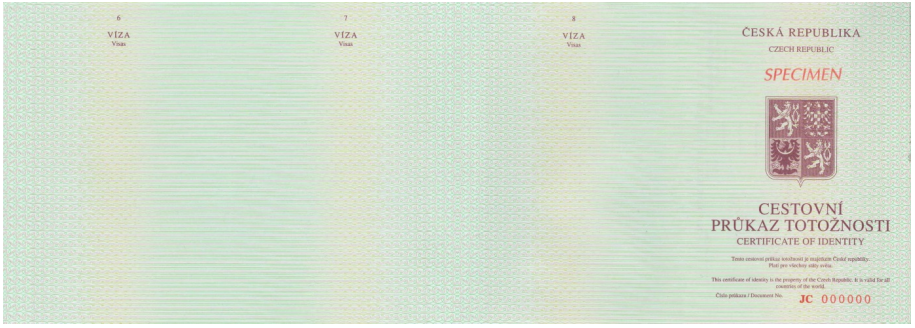
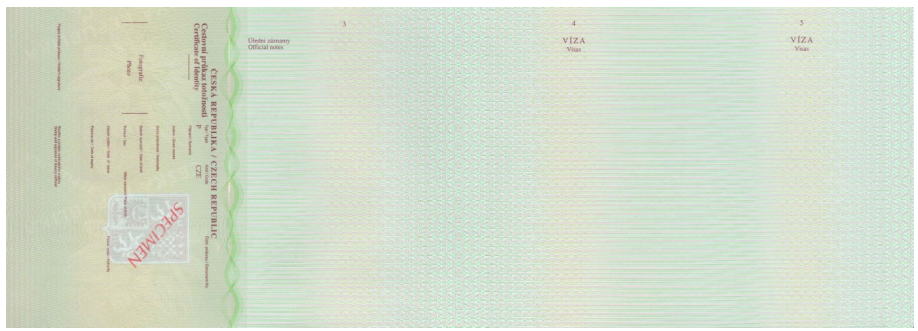
What does a travel identity document look like?
How long is a travel identity document valid for?
A travel identity document is issued for the time of the validity of a residence permit document or a long-term visa but for a maximum of 180 or 365 days.
Is it possible to extend the validity of a travel identity document?
The validity cannot be extended.
In what cases will the travel identity document be removed or not issued?
A travel identity document will be removed or not issued if:
- the reasons for its issuance have ceased to exist,
- an order is issued against you for not complying with a maintenance obligation or monetary liabilities,
- there are criminal proceedings against you or you have not served a custodial sentence imposed by the court provided that the sentence was not pardoned or statute barred.
The decision on removal of the travel identity document can only be taken provided that it is proportionate in terms of its effect on your private and family life.
How and where can you apply?
You can submit an application for a travel identity document at a Ministry of the Interior office, send it by post, Data Box or by e-mail with a recognised electronic signature, or you can submit it through an authorised representative.
What is the administrative fee?
The administrative fee is CZK 600 for adults and CZK 100 for children under 15 years of age. The administrative fee can only be paid by credit card at the Ministry of the Interior office. To be paid upon collection of the document.
What is the time limit to process the application?
30 days.
STEPS TO FOLLOW IN ORDER TO APPLY FOR A TRAVEL IDENTITY DOCUMENT:
-
To apply, you will need:
-
You can download a blank application form, print it out and fill it in by hand, or you can collect the form free of charge at one of the offices of the Ministry of the Interior. The form must be filled in legibly, in block capitals and in Latin characters.
-
You can submit the application in person at a Ministry of the Interior office, send it by post, Data Box or by e-mail with a recognised electronic signature, or you can submit it through an authorised representative.
If you wish to submit the application in person, make an appointment online or by phone beforehand. If you decide to go to a Ministry of the Interior office during opening hours with no appointment, you will have to wait your turn.
-
If you have decided to submit the application in person at a Ministry office, come to your appointment.
If you submit the application in person, you will receive a slip confirming the submission and a reference number assigned to your application. You need to know the reference number, for example, to be able to track the state of your proceedings.
-
The Ministry of the Interior will assess your application in administrative proceedings. If any errors are detected in the application or the attached documents, you will be prompted in writing to remedy such errors. In the notice, the Ministry will explain in detail what the errors are and what you have to do to remedy them. It will also set a time limit for you to do so. When justified and if you apply for it in writing, this time limit can be extended.
In the course of the administrative proceedings, you can exercise the following rights:
- Add the required documents to the application.
- Be represented in the proceedings (a power of attorney).
- Ask for access to file.
- Ask for a stay in the proceedings.
- Withdraw the application (withdrawal of the application).
You can track the state of your proceedings online on the website under Application submitted or in your personal account. If you were prompted to provide documents or to remedy errors, the time limit for the processing of your application is not running until the errors are remedied or for as long as it is established in the notice.
-
On the website under Application submitted you can see the following states:
- Being processed: No decision has been taken yet. For more information on what you can do in the course of the administrative proceedings see the previous section.
- Granted: The Ministry’s decision is affirmative. Consult the following section.
- Rejected: The Ministry rejected your application and closed the proceedings. In such case, you will receive the decision in writing. You can appeal against the decision within 15 days from the date you were notified about the decision. If you need help, you can turn to the Integration centre or other NGOs.
- The decision to reject the application consists of three basic parts:
- The Statement: It contains specific legal provisions based on which the application was rejected.
- The Statement of Grounds: It explains why the application was rejected and what documents and proofs served as grounds for the decision on your application.
- Your rights: It informs you on how to proceed if you wish to appeal against the decision.
- The decision to close the proceedings consists of three basic parts:
- The Statement: It contains specific legal provisions based on which the proceedings were closed.
- The Statement of Grounds: It describes the procedure and grounds that led to the proceedings being closed.
- Your rights: It informs you on how to proceed if you wish to appeal against the decision.